


No conspiracy theories, just facts: A look into key topics of Supreme State Council meeting
09:00, 26 February

Photo by BELTA
Moscow is hosting a meeting of the Supreme State Council of the Union State. Belarus and Russia are set to review the results of the integration and outline plans for the next few years. It has already been officially reported that the agenda consists of seven items. The members of the Supreme State Council will specifically discuss the Key Guidelines for Implementing the Union State Treaty for 2024-2026 and the development of a similar document for 2027-2029. The agenda also includes several practical issues, such as organizing suburban passenger rail service between cities in Belarus and Russia, and establishing a committee for standardization and quality. What else will the supreme body of the Union State discuss? BELTA told.
- Share on Facebook
- Share on VK
- Share on Twitter
What Lukashenko and Putin discussed ahead of the Supreme State Council meeting
In February, the presidents of Belarus and Russia held two telephone conversations to discuss the upcoming meeting of the Supreme State Council. This event, the most important on the Union State calendar, always draws special attention from both supporters and opponents of the Belarusian-Russian integration.
There are few details about what exactly Aleksandr Lukashenko and Vladimir Putin discussed. The press service of the Belarusian leader reported that on 8 February, the heads of state reviewed the agenda and other issues related to the preparation for the meeting, as well as the implementation of joint projects, international topics, and the situation in the region.
A little later, Aleksandr Lukashenko commented on the telephone conversation with his Russian counterpart, noting that various conspiracy theories began to emerge afterwards. But this is hardly surprising: journalists savor any contact between the leaders of Belarus and Russia, putting forward their own theories.
"There has been a lot of conspiracy regarding that conversation. Especially since this issue coincided exactly with the Board of Pease meeting [first meeting in Washington on 9 February] , and my invitation to that Board. Therefore, all our negotiations and conversations with President Putin were overshadowed by this issue. Nevertheless, the main, primary issue we discussed was the meeting of the supreme body of our Union State and our further contacts with the Russian president and negotiations on issues concerning Belarus and Russia,” the head of state said as he met with State Secretary of the Union Sate Sergey Glazyev. “In the run-up to the Supreme State Council meeting, we have a whole host of issues that we need to discuss and, hopefully, reach a common understanding on. It seems to me there are no questions where we cannot reconcile our positions and come to a unified decision.”
Regarding the agenda of the Supreme State Council meeting, Aleksandr Lukashenko positively noted that the Union State apparatus has proposed an acceptable seven items, not several dozen, as was the case in the past. “Well, listen, who is able to discuss 27 items in one go?” he remarked.
The second telephone conversation between the heads of state took place on the evening of 19 February. “Aleksandr Lukashenko and Vladimir Putin compared notes on the agenda of the upcoming event and the most pressing topics to be discussed, both in a broad format and one-on-one. The conversation also touched upon certain issues of Belarusian-Russian relations," the press service of the Belarusian president stated.
What will be discussed at the Supreme State Council meeting
The Permanent Committee of the Union State shared the agenda for the Supreme State Council meeting as early as 17 February. As BelTA has already reported, it includes seven items. In addition to the topics outlined above, the Supreme State Council will explore mutual support and cooperation in the field of international justice, the awarding of the Union State Literature and Arts awards for 2025-2026, the main issues for the Supreme State Council meetings in the current year, and the progress in the implementation of the previous decisions by the Supreme State Council.
Some points on the agenda sound quite general, so throughout the week details of the upcoming meeting have been appearing in the media.
As Sergey Glazyev told journalists, the primary goal of the Supreme State Council meeting is to analyze the Key Guidelines for Implementing the Union State Treaty for 2024-2026. These were approved two years ago by a decree of the Supreme State Council and encompass more than a dozen areas, from common macroeconomic policy to a shared information space.
Experts have already conducted a detailed study of how fully all the plans have been implemented and have prepared a new version of the guidelines. This document will serve as the integration roadmap for 2027-2029.
Head of the Belarus President Administration Dmitry Krutoi noted following Aleksandr Lukashenko's meeting with Sergey Glazyev that of the more than 300 activities planned for 2024-2026, only half have been completed. Delays have occurred in a number of areas, and this will be a subject of close attention from the heads of state. He cited joint industrial projects as an example, explaining that the loan provided by Russia for these purposes has been only half utilized.
“The presidents want to delve into what is happening, what is hindering progress. Next is the topic of protecting our internal market: after all, import volumes are significant in both the Russian Federation and the Republic of Belarus. So, what is being done in this regard? What effective measures have our governments devised?” said the head of the Presidential Administration.
Sergei Glazyev, in turn, explained that the implementation of the other half of the measures will be completed during the year. Thus, the current action program is entering its home stretch.
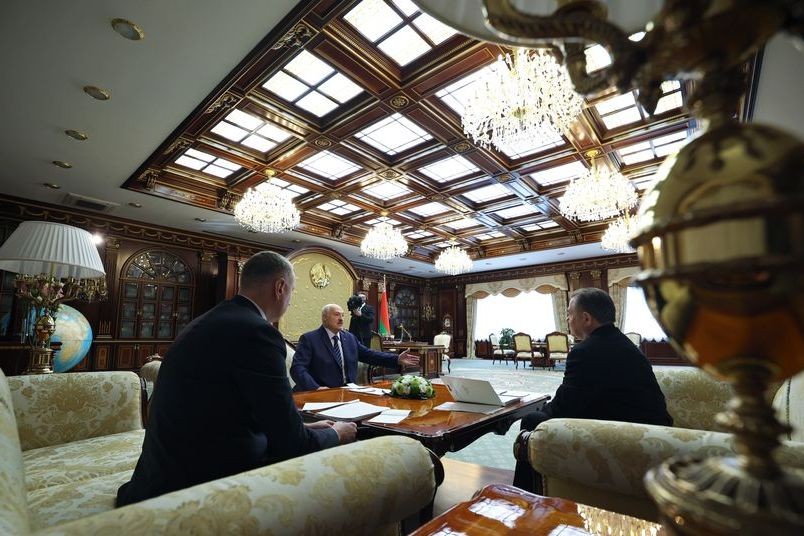
Speaking about promising areas of integration development, Dmitry Krutoi said that the governments will present the outline of the upcoming three-year economic plan at the Supreme State Council meeting. The document itself, as reported in the media, will be finally prepared by autumn.
“Several new items will be added to it, related to digitalization, the creative economy, and certain social areas,” the head of the Belarus President Administration added. “Next is the issue of financial and economic support as a new tool for preparing Union State programs. At the last meeting of the Supreme State Council, it was instructed that it is no longer possible to draw up programs in the same old way, essentially on a declarative basis, without assessing the real results and achievements. There are simply no resources for this. If we set priorities in individual sectors, from microelectronics to pharmaceuticals and healthcare, then these should be tangible projects that can truly deliver breakthroughs.”
According to Dmitry Krutoi, the meeting’s agenda is entirely economic and contains no political elements.
When will direct trains be launched between Smolensk, Orsha, and Vitebsk?
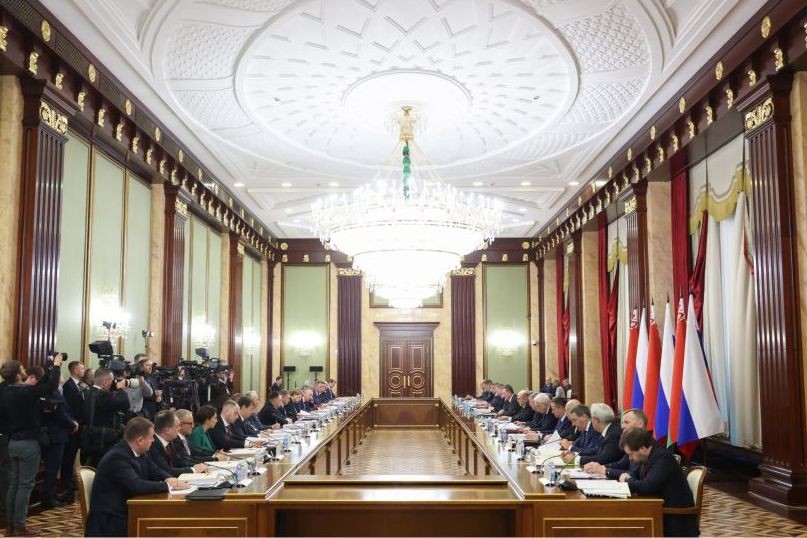
The meeting is set to address the relaunch of direct railway routes between Smolensk and Orsha, and Smolensk and Vitebsk, as part of broader efforts to develop transport links between Belarus and Russia.
It is envisaged that two electric trains will operate daily between the cities – either Russian “Lastochka” or “Finist” trains. All discounts that the citizens of Belarus and Russia have under national legislations will be preserved. A decree will be adopted at the Supreme State Council meeting to launch this mechanism.
In early February, Russian Minister of Transport Andrei Nikitin announced that direct railway service between Smolensk, Orsha, and Vitebsk is planned to launch in April. Moreover, efforts will not stop there.
“The first two routes are Smolensk – Orsha and Smolensk – Vitebsk. In the future, we are looking at Velikiye Luki – Vitebsk, Velikiye Luki – Polotsk, and Bryansk – Gomel,” the minister stated.
Additionally, on the sidelines of the Supreme State Council meeting, a memorandum on the construction of the Minsk – Moscow high-speed railway might be signed. The project is currently being developed.
Overall, work is underway within the Union State on the reconstruction and modernization of railway links, including along the corridor connecting Belarus with the Baltic Sea. The prospects of accessing the Northern Sea Route via Murmansk are being discussed. Whether these issues will be discussed at the forthcoming meeting is unclear. But it seems better to find solutions for one or two pressing topics than to discuss a dozen issues without adopting decisions.
Why does the Union State need a Committee on Standardization and Quality?
The governments of Belarus and Russia believe that the creation of a “Union State product” and a Committee on Standardization and Quality will facilitate the development of industrial cooperation and the implementation of joint projects.
“Their key task is to protect the Union State market and increase the competitiveness of products. Amid today’s aggressive competition, quality is becoming decisive at all levels. The documents being adopted will allow us to reach a new level of cooperation within the Union State, organize constructive work in the common market, and prevent the creation of overlapping and excessive capacities,” noted Belarusian Prime Minister Aleksandr Turchin.
And while positions on the “Union State product” have already been agreed upon (the Union State Council of Ministers approved the decision “On granting products of Belarusian and Russian producers the status of ‘Union State Product’” on 2 February), the decision to create the Committee on Standardization and Quality is yet to be formalized at the meeting.
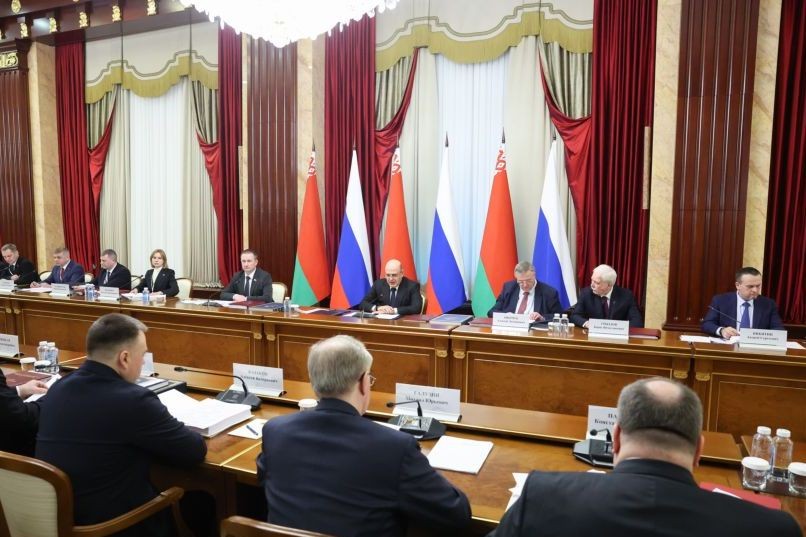
This structure will be overseen by the State Committee for Standardization of Belarus (Gosstandart) and the Federal Agency for Technical Regulation and Metrology of Russia (Rosstandart).
“In the near future, at a joint meeting of Gosstandart and Rosstandart, we will sign three programs for implementation – on machine tool building, trucks, and buses. These three new programs, which involve the development of a number of standards, will also be implemented within the framework of the newly established Union State Committee on Standardization and Quality,” said Yelena Morgunova, Chairperson of the State Committee for Standardization.
When developing the committee’s regulations, the Belarusian side proposed strengthening a focus on eliminating technical barriers in mutual trade between the two countries, primarily resolving them at the expert level, as well as protecting domestic markets from unsafe goods and preventing actions that mislead consumers. “It is essential to find compromise solutions wherever barriers exist, which requires having the appropriate authority to implement them,” emphasized the head of Gosstandart.
For its part, the Standing Committee of the Union State expects that the Committee on Standardization and Quality will become an influential structure, and its authority will cover the widest possible range of issues related to product quality and competitiveness, and interaction with the industrial sectors of both countries.
Can Belarus be torn away from Russia and Russia from Belarus?
Aleksandr Lukashenko has repeatedly emphasized that Belarus intends to work closely with Russia. As closely as Russia is capable of.
“On certain issues, we drifted very far apart, even in the economy. Well, fortunately, circumstances forced us back together in politics, diplomacy, the military-industrial complex, and defense. I always urged that we keep focus on this. There was a time when the Russian leadership and military thought, ‘What do we need Belarus for? We can manage on our own.’ But time has shown how few true friends we have. We simply cannot do without each other. And thank God, time has put us all in our place,” Aleksandr Lukashenko emphasized at a recent meeting with the state secretary of the Union State.
Every now and then, one can read in the media about someone’s attempts to tear Belarus away from Russia. Commenting on this issue, the Belarusian leader said: “There is no force capable of separating Belarus from Russia and Russia from Belarus. The circumstances united us into a single whole for many decades and centuries. There is nothing to blame Belarus for. We have always been aligned with Russia. A lot connects us with Russia if not everything. There are our resources, our market there if we talk about the economy. We have complete unity in this regard. And in the political [dimension], too.”
Attempts to build a single space also stem from the centuries-old ties between the two peoples. Do forces capable of severing such relations really exist?
“We long ago settled on the formula: we have one common Fatherland from Brest to Vladivostok. Well, it wouldn’t be bad if it were from Lisbon to Vladivostok – at least economically. But that doesn’t depend on us. But from Brest to Vladivostok – this Fatherland we cannot lose. We defended and fought for it together for centuries, not just in the last war. And it doesn’t belong to Putin or Lukashenko. We are still ‘green’ compared to our ancestors who defended this space for centuries. We have no right to tear it apart,” the head of state emphasized. “But in this Fatherland, there are two states. Two sovereign states, dependent on each other.”
Any meeting of the Supreme State Council is not about loud statements and declarations, but about an attempt to calmly and substantively sort out what is already working and where the process is stalling. Enough issues have accumulated, and now the important thing is not just to name them, but to agree on concrete steps. It will be precisely from such decisions that the next stage of the Union State interaction will become clear.


