Lukashenko: Economy is now the real battlefield in ‘almost wartime’ conditions
12:25, 17 February

photo: BELTA
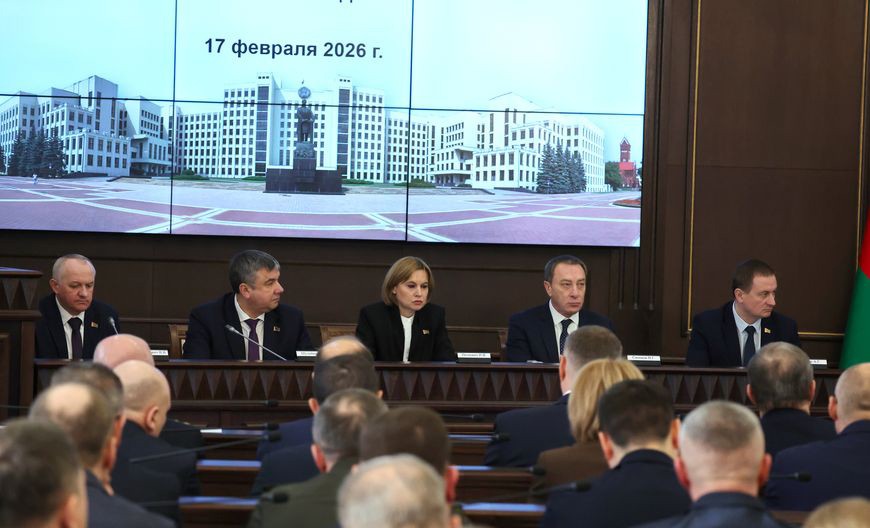
The economy has become the real battlefield, Belarusian President Aleksandr Lukashenko said as he received the government’s report for 2025.
- Share on Facebook
- Share on VK
- Share on Twitter
“This is not a ceremonial event. I very much want it to be a working meeting,” the head of state emphasized immediately upon arrival. “We find ourselves in a very complicated situation. Under serious pressure from both the East and the West. I am speaking about the economy. Although, as the classics said, politics is the concentrated expression of economics. Nevertheless, we are economically squeezed between two powerful blocs. On one side is the European Union. On the other are the People’s Republic of China and Russia. Our main ally and partner is in a very difficult position, and we feel this because it is our primary market.”
Aleksandr Lukashenko noted that the day before, during a meeting with State Secretary of the Union State Sergey Glazyev, they had discussed the economic situation in the common space. “We came to a consensus that it will not be easy,” he said.
“Well, that is precisely why we are what they call the elite, the most prepared and informed people. And in any situation, we must work and deliver results. Therefore, I urge you to have a very frank conversation. There is no need to embellish anything. Carefully, subtly, but even when inspecting the Armed Forces, we speak openly about our shortcomings. Something that is generally never done in any state,” Aleksandr Lukashenko said.
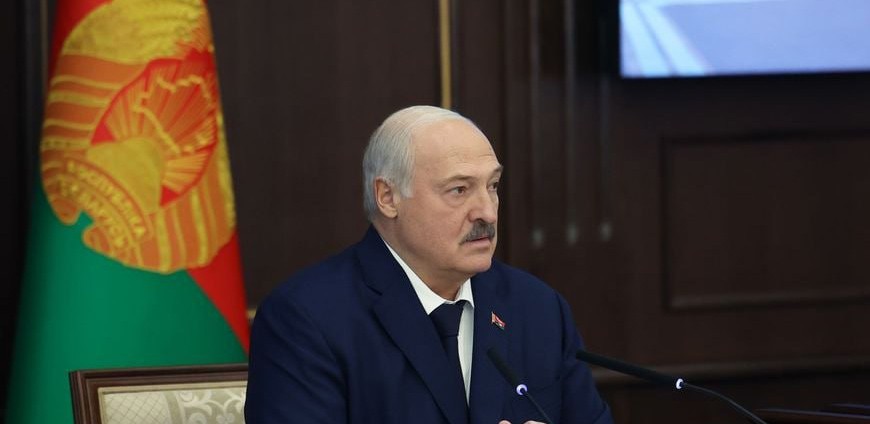
“The times are almost wartime. Why? The economy has become the real battlefield. The goals of classical warfare are being achieved through economic instruments: to appropriate resources, to provoke social unrest, to force compliance with others’ rules – to live by different rules,” the head of state said. “I want you to open your eyes and understand how the world is developing. The Lord has saved us from that awful, incomprehensible market economy. Remember, we were constantly taught: the market will regulate everything. We didn’t abandon anything, we endured, and today we understand: no market regulates anything. He cast an eye to the north - Greenland is rich and so on, let’s take it. Even Canada, one of the largest countries in the world, should become the 51st state. Venezuela: they seized the president. What cartel? What drugs? Oil!”
“I am grateful to the U.S. president for doing this openly. Now we understand where they were dragging us. Through some liberal principles, they convinced us that we must act one way and not another. We held out, we understand what to do, where to go. We must rely only on ourselves. We shouldn’t count on anyone. At best, our closest friends are our competitors,” the head of state emphasized.
Aleksandr Lukashenko listed the economic instruments being used for the purpose of exerting pressure.
First - sanctions. “But for you and me, they don’t exist. If we had started citing sanctions, we would no longer exist,” the Belarusian leader emphasized. “The moment we get it into our heads that it’s impossible to work, that's it, we will perish. Times are tough. The poor results in January show that it’s going to stay tough. But there are responsible people everywhere who need to deliver. No results, and we’ll end up with a war economy. And in that environment, they don’t stand on ceremony.”
The head of state noted that over fifty countries worldwide are under the direct effect of sanctions, while the secondary effect probably already impacts hundreds of nations. Aleksandr Lukashenko supported the idea of creating an association of countries around the world that are under sanctions, including China. “If we unite and come to an agreement, those who imposed sanctions on us will be frightened,” the president said.
Second - embargoes. “Through trade blockade and asset freezes, they are strangling Cuba today before the eyes of the whole world,” Aleksandr Lukashenko cited as an example.
Third - tariff wars. Here the arsenal includes duties, quotas, and bans on the import and export of specific goods.
Fourth - currency attacks. “By restricting the circulation of the U.S. dollar, applying pressure to the exchange rate and settlements in a particular currency, they attempted to stage a color revolution in Iran,” the president said.
Fifth - the struggle for technology. Here, competition takes its most blatant, neo-colonial form, the Belarusian leader noted. This encompasses prohibitions on the delivery of equipment, chips, and software, along with the denial of access to high-tech sectors.
Sixth - control over supply chains, i.e. an attempt to make other countries dependent on logistics and infrastructure.
“Belarus has fully experienced this entire bouquet of ‘civilized rules’ firsthand. Nevertheless, as we once agreed, we study and understand the external conditions, but we must work under the constraints and sanctions,” Aleksandr Lukashenko emphasized.
The head of state outlined the meeting’s agenda as reviewing the government’s performance in 2025 and determining the economic prospects for the current year.
Moreover, the results for January 2026 are already known. The president had been briefed that the government and the National Bank, along with the chairpersons of regional executive committees, completely failed in January.
“I deliberately postponed the government’s report until this time so that we would have the precise results of last year and also receive the results of the first month, in order to assess the situation and see the trend,” Aleksandr Lukashenko said.
“The government is not only the prime minister, his deputies, and ministers, but also the staff of the Council of Ministers and the directors of key organizations, without whom no issue can be resolved. That is precisely why I asked members of the government and our leading figures to be invited, so they would understand the responsibility that lies upon us this year,” the president noted.