


Belarus considers three sites for radioactive waste disposal facility
23:40, 2 September

Photo: BELTA
A decision on the site for a radioactive waste disposal facility may be made by the end of 2026, Belarusian Energy Minister Denis Moroz told the media at a press event marking the 25th anniversary of the Energy Ministry, BelTA has learned.
- Share on Facebook
- Share on VK
- Share on Twitter
“Even before the final commissioning of the nuclear power plant, we were already working out how we would handle radioactive waste. A decision was made on the need to build a disposal facility. To this end, a special radioactive waste management company, The Belarusian Organization for Radioactive Waste Management (BelRAO) was established, and it is currently organizing this work. Radiation safety is a priority for our country. The IAEA has documents that set out the procedural requirements for the construction of radioactive waste disposal facilities,” Denis Moroz said.
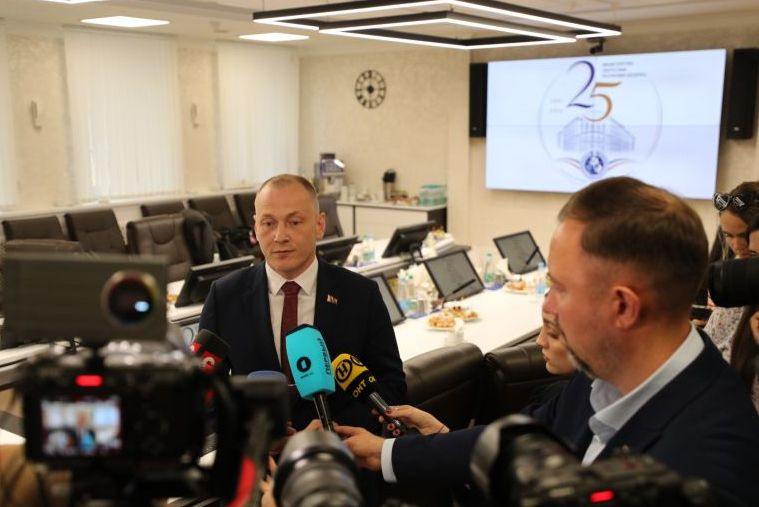
An important part of the work was identifying potential sites for the facility. Three alternative sites are being considered for the radioactive waste disposal facility: Khoiniki District (Gomel Oblast), Ostrovets District (Grodno Oblast), and Mstislavl District (Mogilev Oblast). “This is a specific type of facility. There are certain requirements regarding geology, hydrology, and other parameters. We carried out extensive work and analyzed the entire territory of Belarus. Initially, we identified around 20 potential sites. The expert community then determined that three sites had the greatest potential, and an environmental impact assessment was carried out for them. This is already the predesign stage, when the details of the facility’s construction are being worked out,” the minister said.
After the environmental impact assessment, public consultations are held.“They will be completed in September. And by the end of this year, a decision will be made. It will be a well-considered decision made collectively on the basis of many criteria and taking into account a large number of factors,” he stressed.
According to him, the facility will occupy an area of no more than 100 hectares. Denis Moroz also explained how radioactive waste will be disposed of. “The waste is placed in a special concrete container. Inside the container, it is turned into a glass-like mass: it is either cemented, or embedded in liquid glass, or other methods are used. It is turned into a solid material that is not affected by water or anything else. These containers are placed in constructed vaults. Once the vaults are filled, they are covered with inert materials, essentially sand, to ensure that there is no external impact. The vaults are then sealed, and we forget about them for the next 600-700 years. Our disposal facility does not provide for the retrieval of radioactive waste. It will remain there and will not require human intervention,” he said.


