


Lukashenko: All districts in Belarus must become at least as good as Shklov District
11:00, 9 November

Photo: President.gov.by
Shklov District is not in an ideal state, but it can serve as a model for districts of an average level and below, Belarusian President Aleksandr Lukashenko said at a working meeting that concluded the seminar on modern approaches to regional development using Shklov District as an example, BelTA has learned.
- Share on Facebook
- Share on VK
- Share on Twitter
Aleksandr Lukashenko stressed that although Shklov District is his small homeland, he has an identical attitude towards any other “corner” of Belarus, and especially towards the so-called remote places.
Heads of all 118 districts of Belarus were invited to the seminar-meeting to adopt experience and share their own practical know-how. “The main thing is for you, having seen it, to do it in your own district,” the head of state addressed the participants.
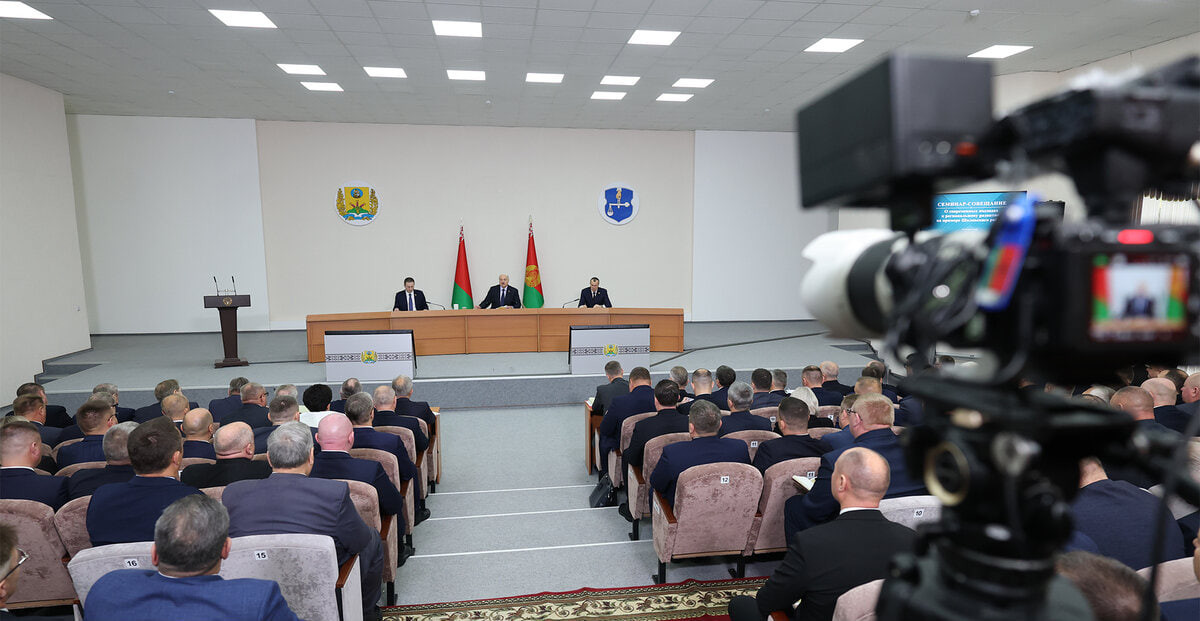
The President stressed that he is far from thinking that Shklov District has been brought to an ideal state and that everything has been done here. It is, rather, an average district. But it would be good for all districts to be at least like this one. And those districts that are far better than Shklov District must on no account lose their positions. “There are enough such districts in the country [with a higher level of development]. But those that have to be ‘pulled up from the basement’, and the middling ones, that is Shklov District, they must be like this,” the head of state explained. “This is an average, ordinary district. And if, during my presidency, we achieve this throughout the country, that will be enough.”
Aleksandr Lukashenko drew attention to the fact that in Shklov District they sought not only to create new things but also to restore and develop the facilities that remained from Soviet times. This is similar to the path China has chosen for itself - not to break or reject the old, but to take the best from it and develop it.
The President drew attention to the fact that there is much that is good in a market economy, but some in the post-Soviet period became too carried away with the idea that the market would regulate everything, and the result was ruin. This concerns, among other things, organizations that are basic for a district - the district agricultural service company, the mobile construction unit, the base for storing and processing mineral fertilizers and others.
Another example is the former furniture factory in Shklov, where they plan to place a modern production of steel structures. “We visited it. Why I brought up the furniture factory is to show you that nothing needs to be destroyed. And what can work today must be made to work,” the head of state said. “Thanks to the Minsk mayor, who took on this facility. And I am confident that by the end of next year there will be a high-tech production there, whose products will be needed across the country.”
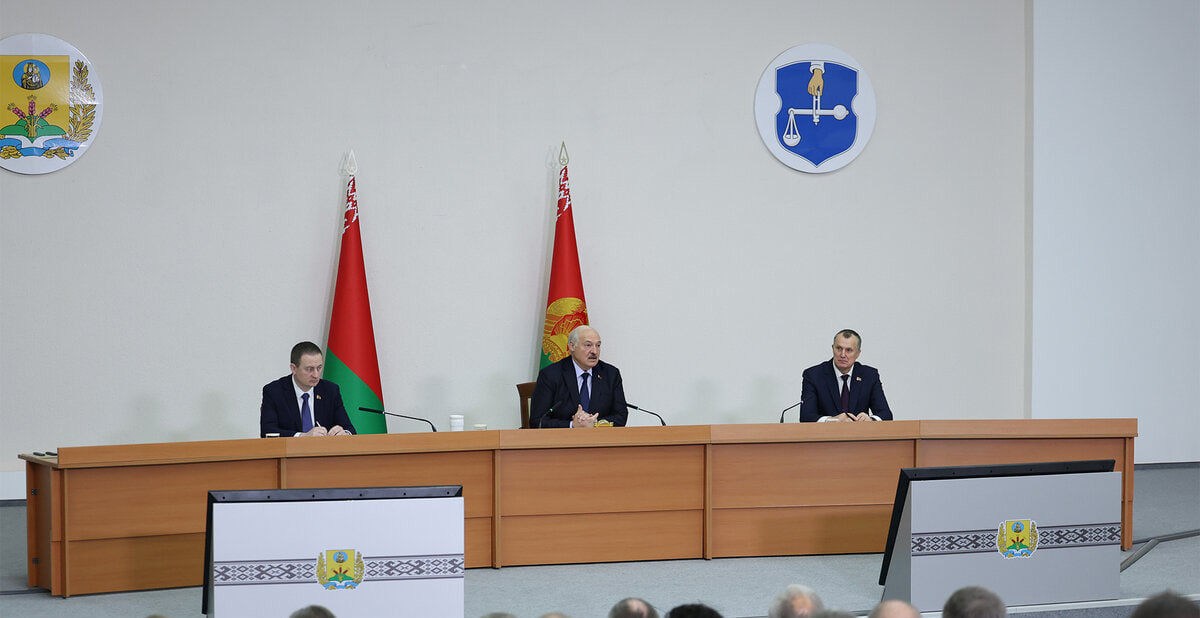
The head of state placed particular emphasis on the country’s natural resources: “The main thing Belarus will always be engaged in is timber processing, woodworking enterprises. This is a huge timber-processing program that takes us into solid markets, and demand for this product will grow. And agriculture - prices are rising madly [for food in the world]. These are the two directions that Belarus will never abandon.” And Shklov District has the enterprises that work in these sectors.
Aleksandr Lukashenko drew attention to the fact that Belarus already exports $10 billion worth of food a year. “The highest-quality products are Belarusian. Recognized throughout the world. Why not engage in this? This requires modern machinery, which is what we are doing. Our agricultural machine building has been decent since Soviet times. Now it has been brought to the world level. But the quality needs to be improved. These are our two areas,” the head of state said.
The head of state’s instructions on the flax-growing industry lie in the same vein. In this he also sees one of the areas of development not only for Shklov District: “We searched the whole world for the equipment needed for the flax plant. We found it and modernized it. We make good fabrics. Linen fabrics are gold. The flax-growing industry must be brought to a higher, more perfect, more technological level. And this must be pursued.”
Much has also been done in developing the trade, transport and social infrastructure in Shklov District. “Shklov District is a point that must be developed and made to yield a good effect. Everything necessary has been created here [for development]. Now the floor is with the district executive committee chairperson and the governor. Push on and get to work. Control will be extremely strict. I promise you that,” the President said to the local heads.
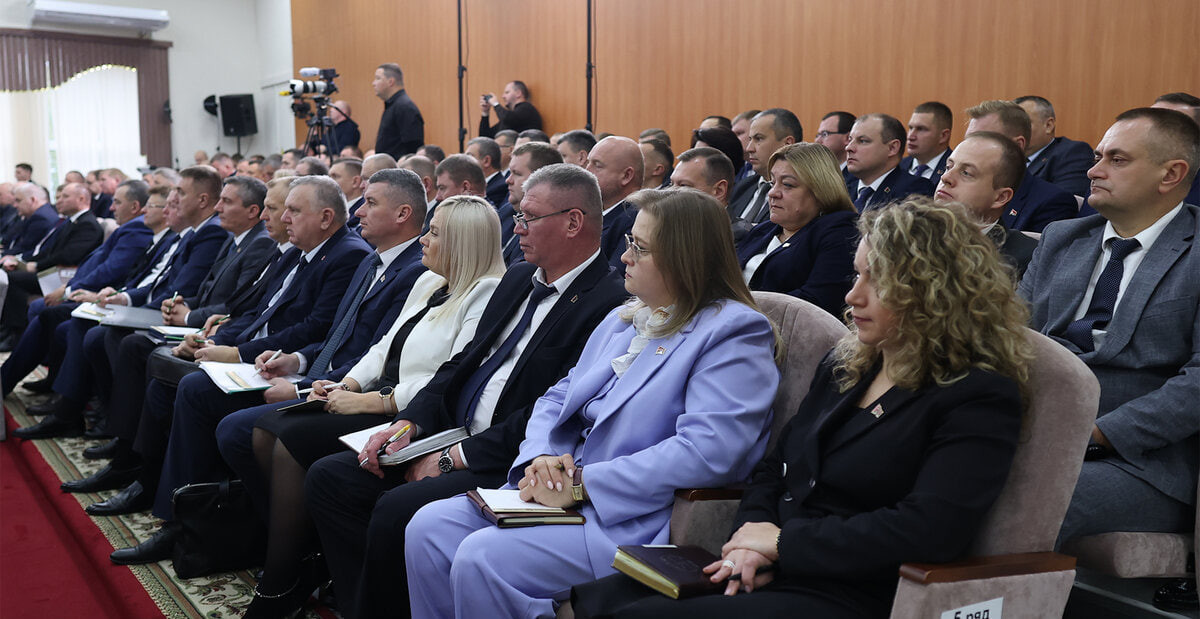
“But no less important are Mstsislavl District, Gorki District, Dribin District, Mogilev District, Belynichi District and Krugloye District - this is a large tract of Belarus with good land. And something must be got from this land,” the Belarusian leader stressed. He drew attention to the fact that the soils here are good, and the return from them could be greater.
Aleksandr Lukashenko stressed that regional heads bear colossal responsibility, since it is economically strong regions that are one of the key priorities of the social and economic development program adopted at the Belarusian People’s Congress.
The President recalled that the country had earlier identified supporting population centers - 1,500 agrotowns that need to be developed so that people live there. “There must be everything in agro-towns that there is in a small town or a district center. All district centers will be linked to agro-towns by good roads during this five-year period,” the Belarusian leader said.
The head of state turned to the issue of consolidating and merging farms. It is important that this process be approached thoughtfully, rather than simply hanging “weights on the legs” of more efficient enterprises, which could ultimately have a negative effect on their work as well. “Do not rush to merge. Merging must be done for a purpose,” Aleksandr Lukashenko said.
The personnel issue is no less important, starting from machine operators. Competent specialists must be assigned to high-powered, expensive machinery.
The President stated that over recent decades many rural residents have moved to the cities. “People have been taken from the rural areas - we need to help. We must not move away from patronage assistance. Or transfer them into ownership, as branches [a reference to transferring farms to the management of industrial enterprises]. But we should move in that direction. It is a good option,” he added.
The head of state also addressed the issue of subsidies for agricultural producers. Approaches in this area will soon be revised so that funds go exactly where they are needed and produce the maximum effect.


