


Belarus eager to help build infrastructure, power plants, ports in Russia’s Far East
13:29, 3 September

Photo: BELTA
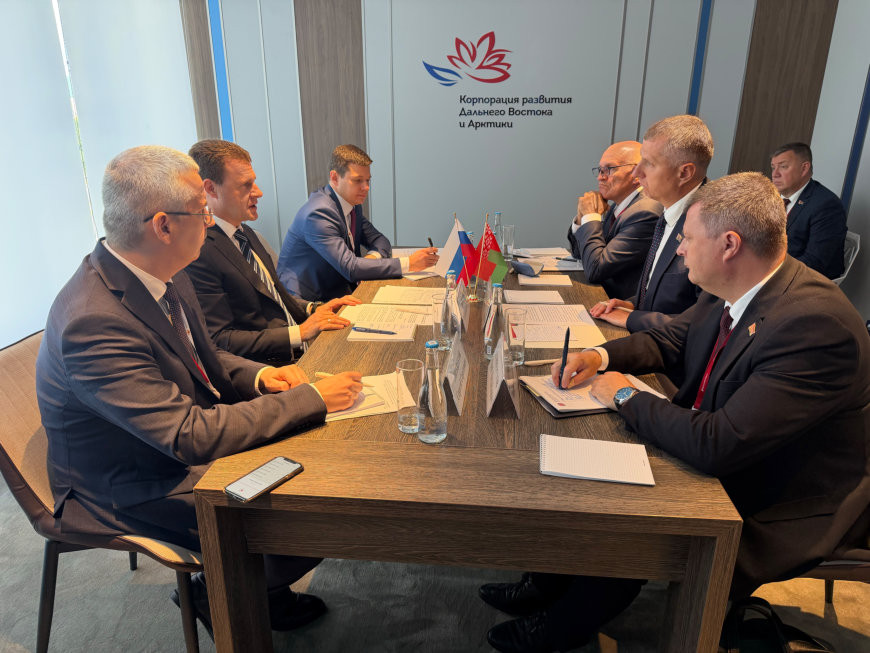
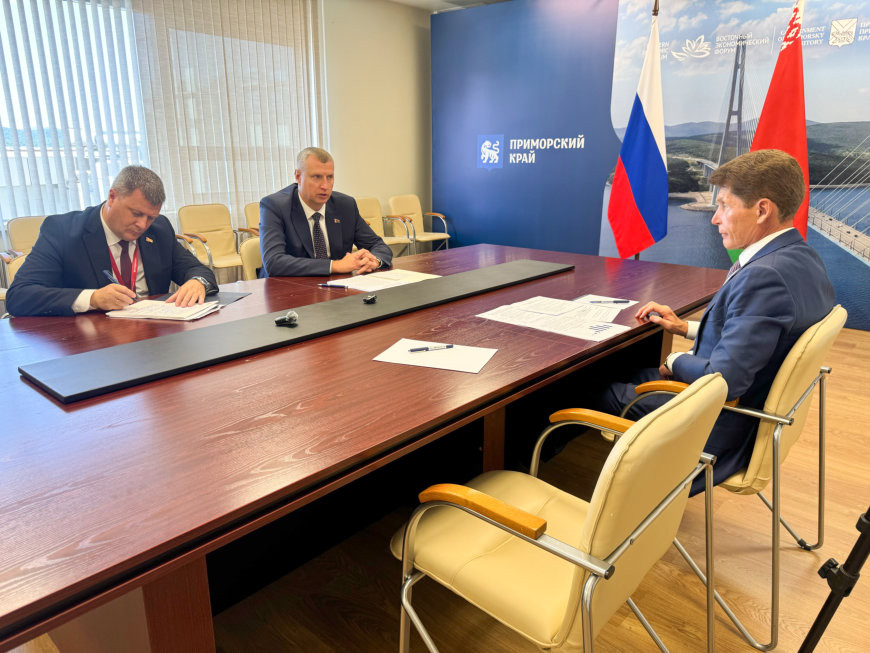
Belarus intends to take part in infrastructure projects in the Far East, including those relating to the construction of power plants and port infrastructure. Head of the Belarus President Administration Dmitry Krutoi mentioned the plans in front of reporters in the city of Vladivostok, Russia on 3 September, BelTA has learned.
- Share on Facebook
- Share on VK
- Share on Twitter
In Vladivostok during the Eastern Economic Forum Head of the Belarus President Administration Dmitry Krutoi met with Governor of Russia’s Khabarovsk Territory Dmitry Demeshin, Head of the Republic of Sakha (Yakutia) Aisen Nikolayev, Governor of Russia’s Kamchatka Territory Vladimir Solodov, Governor of Russia’s Jewish Autonomous Region Maria Kostyuk, Governor of Russia’s Magadan Oblast Sergei Nosov, and Vladivostok Mayor Konstantin Shestakov.
Dmitry Krutoi noted: “We’ve had very productive meetings with heads of Russian regions, with leading ministers, members of the government. We had to make sure that the Far East is still prioritized for development and financing. The resources allocated to the Far East Federal District are unprecedented. Moreover, all these resources will be virtually doubled as part of a new program. There are several fields Belarus must participate in. And we’ve discussed it with Far East governors. The development of infrastructure is the first priority. The region has a shortage of energy. New power-generating facilities are going to be built. In particular, two nuclear power plants. The decision has been as good as made today. The governors are interested in our competences and the experience of construction of the Belarusian nuclear power plant in the town of Ostrovets – one of the most up-to-date nuclear power plants built by Rosatom. We are going to establish industrial cooperation.”
Another interesting project is the development of power plants leveraging the tidal energy in Kamchatka Peninsula. “Soviet scientists secured a headstart back in the day. There is an appropriate site: Penzhina Bay. The governor would like our power engineering companies to surely provide assistance starting with design and ending with the shipment of equipment,” the head of the Belarus President Administration noted.
The second track of infrastructure development is the Northern Sea Route. “It is already transforming into a broader Trans-Arctic Transport Corridor project that will involve more local projects related to rail and road transport in addition to the maritime component. Within the framework of the Northern Sea Route several governors invited us to participate in the construction of port infrastructure. As for those investors who have failed to deliver, the ports will be returned to federal ownership under the relevant court rulings. Belarusian companies and Belarusian residents have been offered to stake a claim in the Northern Sea Route. This is a very interesting topic,” Dmitry Krutoi stressed.
Apart from that, upon instructions of the president, the topic of the “northern shipments” was discussed during recent meetings with Far East governors. This is a complex of annual state measures to provide the territories of the Far North of Siberia, the Far East, and the European part of Russia with essential goods (primarily food and petroleum products) ahead of the winter season. “The Russian Federation has changed its legislation. A new law on the ‘northern delivery’ was adopted. And now it is important to understand how Belarusian shipments will reach these regions on a systemic basis because this is a very attractive form of supplying our products, primarily food. Right now they also have a huge need for fuel. We discussed practical steps for our companies to participate in the ‘northern delivery’,” Dmitry Krutoi noted.
During the meetings with the governors shipments of Belarusian products were discussed as a whole. “The positions of our mechanical engineering companies are traditionally strong. But there is an interesting trend that became clear as a result of the negotiations: it is necessary to offer vehicles powered by gas. This primarily applies to MAZ, BelAZ, and perhaps partly to MTZ. The situation on the fuel market prompts mine operators and those companies that use our MAZ road tractors to utilize gas reciprocating engines. City mayors suggest the same for municipal vehicles. This option saves money and reduces dependence on traditional fuel shipments. Many regions have adopted a policy of carbon neutrality, this is why such vehicles will enjoy the highest demand,” Dmitry Krutoi pointed out.
The negotiations also focused on the matter of the chain of specialized Belarusian food stores. “Now governors suggest going further. Among other things they suggest using the capabilities of marketplaces. Ozon and Wildberries will build huge distribution hubs specifically in the Far East. They have more serious capabilities for reducing logistics costs. Belarusian goods – not only food, but also light industry products as well as construction materials — could reach the Far Eastern regions at more comfortable prices using the capabilities of marketplaces,” the head of the Belarus President Administration added.
Dmitry Krutoi is attending the Eastern Economic Forum in Vladivostok these days. This is a leading platform for developing the economy of the Far East and expanding international cooperation in the Asia-Pacific region where Belarus can promote its interests. The forum has brought together representatives of government agencies, the private sector, and the expert community from various countries for the sake of working out joint solutions, developing partnership, and launching new projects. An extensive business program is part of the forum. It includes a plenary session, thematic sessions, business dialogues, panel sessions, and expert discussions across various thematic tracks, including “The Far East – a pole of international cooperation”, and “Technologies of the present and future”.


