


92.6% of Belarusians support good relations with all countries
15:30, 23 September

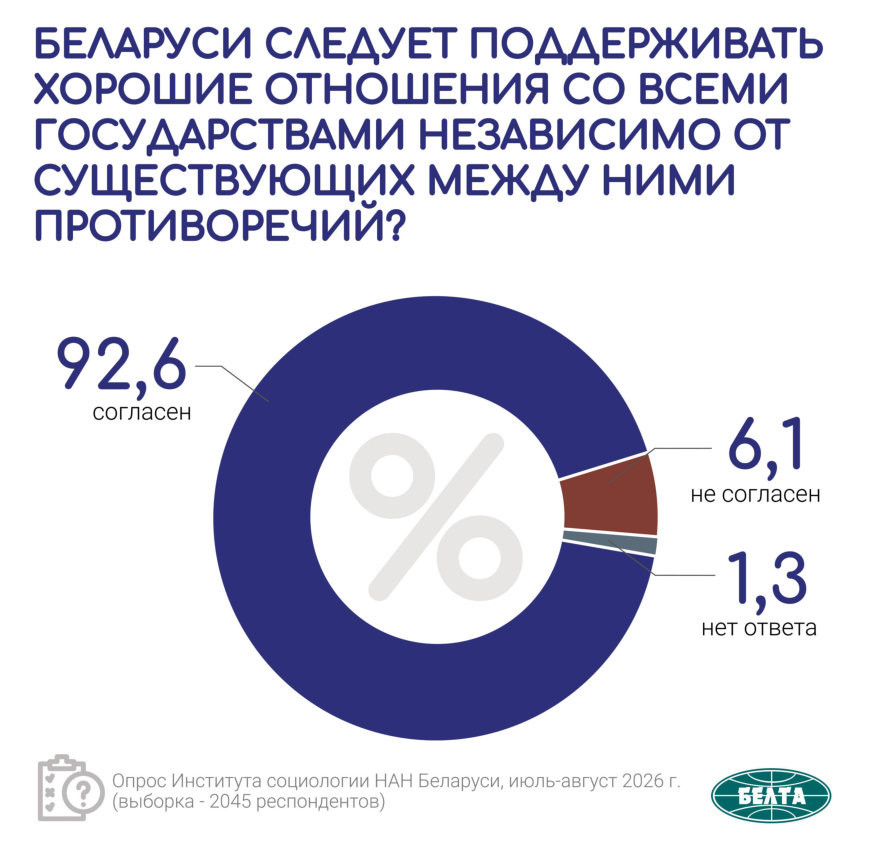
The overwhelming majority of citizens - 92.6% - believe that Belarus should maintain good relations with all states regardless of existing contradictions between them. These are the results of a comprehensive republican sociological study concerning topical issues of the international and domestic agenda, BELTA reports.
- Share on Facebook
- Share on VK
- Share on Twitter
Only 6.1 percent of respondents disagree with this thesis. According to Vitaly Punchenko, Deputy Director of the Belarusian Institute of Strategic Research, the survey results demonstrate that Belarusians tend to independently form a sovereign assessment of Belarus's international partners, and to consider relations with each state separately in a balanced and rational manner.
Alexander Lukashenko has repeatedly stated that Belarus is the most peace-loving country and that the Belarusian people want exclusively peace, Vitaly Punchenko emphasized, recalling that the anthem of Belarus begins with the words "We, Belarusians, are peaceful people, devoted in heart to our native land…"
"Peace, security and freedom are not simply state-forming values of Belarusians, but a historically established ideal of society, an important part of the national self-awareness of the people. Goodwill and peacefulness are our national brand and the foundation of our cultural code," he noted.
The deputy director of BISR noted that the concepts of "moderation" and "tolerance" have become firmly established in the Belarusian mentality. This is the ability to coexist peacefully with representatives of different nationalities and confessions, which has been forged over centuries at the crossroads of different cultures and religions. "Our country has for centuries been an arena of destructive wars. The deepest scar in the national memory remains the Great Patriotic War, in which every third resident perished. The tragedies experienced have formed a steadfast rejection of violence and aggression. The main value for many generations has become a peaceful sky above their heads," said Vitaly Punchenko.
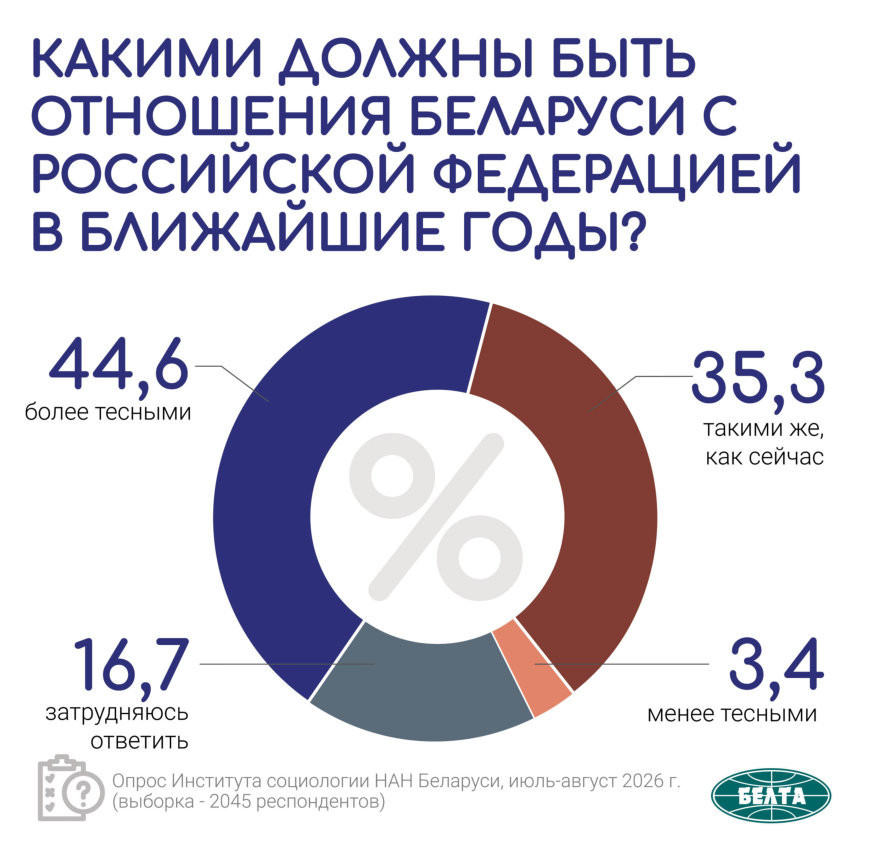
The survey once again confirmed: Belarus's separation from Russia is impossible. Vitaly Punchenko noted that the relations between the two peoples are not merely allied, but brotherly. "The high figures of support for close relations with Russia are confirmation of the friendly disposition of Belarusians toward Russians. The economic and social advantages of integration within the framework of the Union State have become truly attractive, as they expand the rights and opportunities of citizens in the spheres of business, education, culture, tourism, and interpersonal communication," he emphasized.
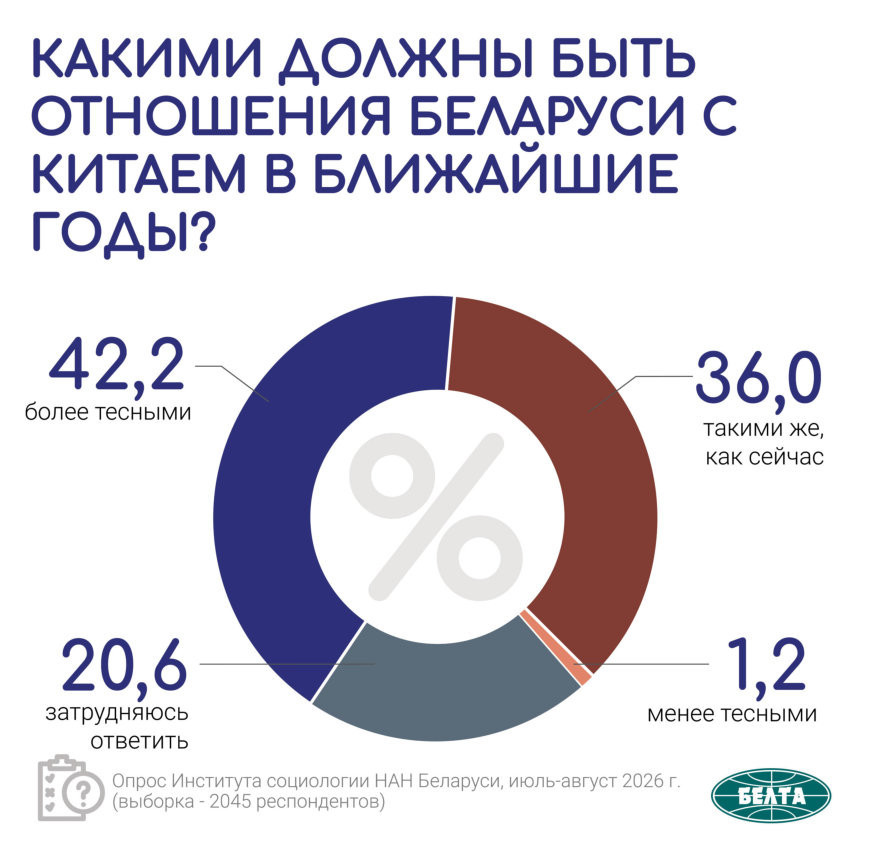
The results of the study show that relations with China are perceived by Belarusians as highly promising. In terms of the demand for closer ties, Beijing came immediately after Moscow. At the same time, young people demonstrate increased interest in the PRC, which serves as a marker of the long-term nature of the Belarusian-Chinese track.
The position of citizens regarding the United States showed caution and restrained optimism. A readiness for pragmatic normalization of interaction is gradually forming. At the same time, uncertainty among citizens is still evident, which is connected with many years of political and economic pressure on Belarus from the White House.
The centuries-long history largely shapes the attitude of Belarusians toward neighboring peoples, noted Vitaly Punchenko. Therefore, even against the backdrop of the current policies of the leadership of Poland, Lithuania, Latvia and Ukraine, the number of those who support closer relations with these countries in the coming years is approximately three times higher than the share of supporters of less close ties.
"The constant information pressure of these countries on Minsk has led to the opposite result. The interest of the Belarusian population in 'unfriendly' states is declining, and attitudes toward them are becoming blurred. Nevertheless, a significant portion of respondents still consider it desirable to improve interaction with neighbors, drawing a distinction between peoples and current governments," he noted.
On the whole, emphasized the deputy director of BISR, Belarusian society manages to preserve common sense and conflict-free thinking even in conditions of inter-civilizational confrontation. "This is our strength and uniqueness," summarized Vitaly Punchenko.
The sociological study was conducted in July–August by the Institute of Sociology of the National Academy of Sciences of Belarus on behalf of BISR. It involved 2,045 respondents from all regions of the country.


