


Head of Russia’s Altai Republic outlines joint projects with Belarus
13:46, 29 October

Photo: the press-service of the President
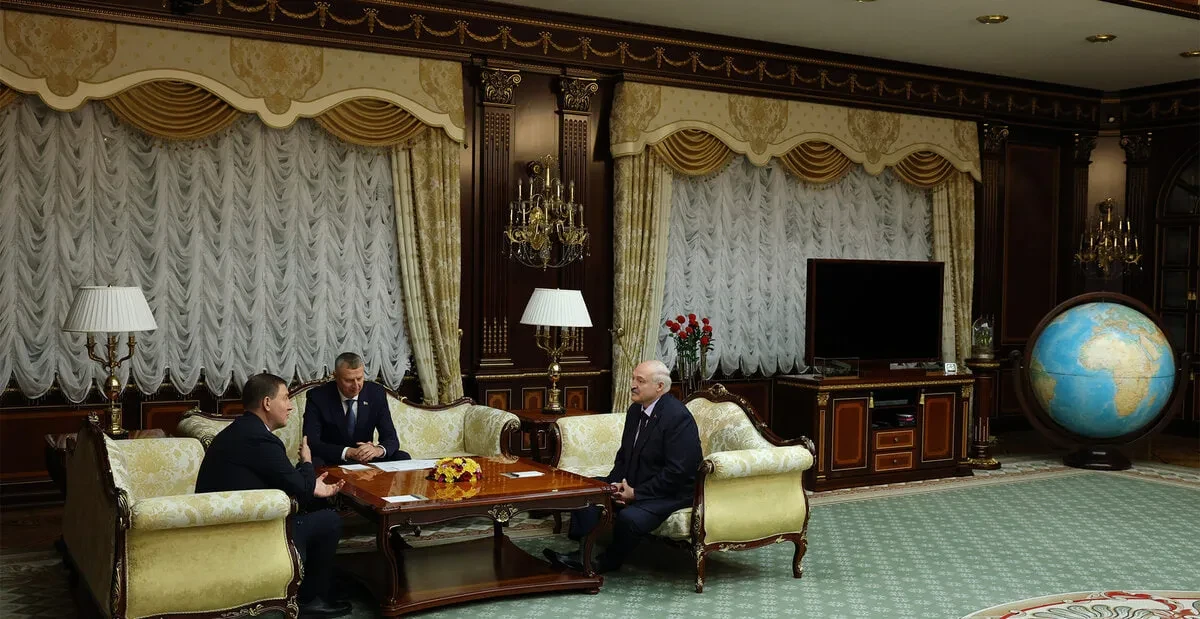
Following the meeting with Belarusian President Aleksandr Lukashenko in Minsk on 29 October, Head of Russia’s Altai Republic Andrei Turchak spoke to journalists about promising joint projects, BelTA has learned.
- Share on Facebook
- Share on VK
- Share on Twitter
The parties agreed to explore the possibility of establishing direct flights between Minsk and Gorno-Altaysk. “In today’s world, the thousands of kilometers separating the Altai Republic and Belarus are just within arm’s reach. And the most crucial agreement reached is that both sides will explore the possibility of establishing direct flights between Minsk and Gorno-Altaysk,” the regional leader said. He mentioned that the airport in the Altai Republic’s capital was recently granted international status, and a new terminal will soon be constructed, along with an extended runway.
“We agreed with Aleksandr Grigoryevich [Lukashenko] that this will be the first step we take to turn thousands of kilometers into a maximum of five hours,” Andrei Turchak added. He is convinced that this will help boost trade, economic ties, and tourist exchanges.
Furthermore, the Altai Republic plans to select an 8-hectare plot of land within its resort zone for the construction of a Belarusian health resort. The core concept is to pool the resources and expertise of both sides. The Russian region is renowned for its large population of Caspian red deer, as well as the processing of velvet antlers (young, non-ossified antlers of red deer, which feature a rich amino acid, vitamin, and mineral profile). These antlers are used to manufacture products for dietary supplements, health, and longevity.
Notably, the Altai Republic is home to a vast number of valuable herbs, including over 200 endemic species that are found nowhere else. The parties are discussing the possibility of utilizing them for the joint production of medicines, dietary supplements, and food additives, potentially involving Belmedpreparaty.
There is also a strong interest in cooperation in agriculture. “About 70% of our population lives in rural areas. We have two pillars: tourism and agriculture. The competencies in the agricultural industry that Belarus has built over the years can be highly beneficial to us,” the regional leader pointed out. He suggested that the Belarusian side implement a relevant project based at a local agro-industrial park. At the same time, he explained that the region does not require large volumes of machinery, so cooperation does not primarily focus on this area. A more realistic approach is to increase two-way tourist flows. “Our agricultural producers buy about 110 tractors a year on average, and 95% of them are MTZ. We bought them and will keep buying them. We won’t bring anything new to this area. We aren’t going to buy thousands of buses, hundreds of agricultural drones, and so on. There will be occasional individual purchases, but that is not where the core interest lies. The real interest is to have at least 15,000 Belarusians visit the Altai Republic by the end of next year for various purposes,” the head of the region explained.
Andrei Turchak noted that Belarus and the Altai Republic are at the beginning of their journey toward building strong trade and economic ties. Therefore, it is still premature to talk about specific trade figures. “The money will come. What matters is that both sides are ready to share their competencies,” he said.


